
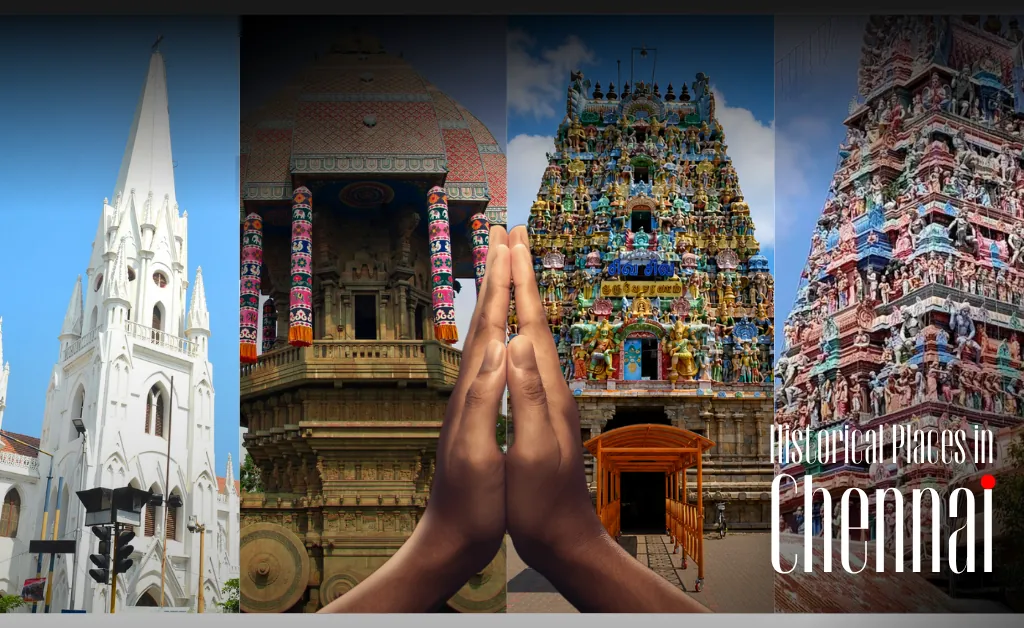
Chennai doesn’t show you its history. It lives it.
The city that the British called Madras has been shaped by four distinct civilisations — Pallava kings, Portuguese missionaries, British colonisers, and the Tamil cultural renaissance that followed independence. Each left behind something you can still walk into today.
The historical places in Chennai aren’t cordoned off behind ropes. Temples built in the 7th century still hold morning puja. A 1644 British fortress still houses government offices. A Gothic cathedral still rings its bells on Sunday mornings over the sound of the Bay of Bengal.
This guide covers 12 of the most significant historical sites in the city — organised by era, with visiting hours, entry fees, Google Maps links, and practical tips so you can plan your heritage tour without the guesswork.
Table of Contents
Quick Answer
Chennai’s most significant historical places include Fort St. George (1644), Kapaleeswarar Temple (7th century), Santhome Cathedral (1896), and the Government Museum (1851). The city layers Dravidian, Portuguese, and British history across walkable neighbourhoods like Mylapore and George Town, making it one of South India’s richest heritage destinations.
Why Chennai’s History Is Unlike Any Other Indian City
Most Indian cities have one dominant historical layer. Jaipur has the Rajputs. Agra has the Mughals. Old Delhi has them both but in separate chapters.
Chennai has four layers — and they overlap.
Within a 10-kilometre stretch, you can stand inside a 6th-century Pallava temple, walk to a Portuguese-era cathedral, have lunch in a colonial-era public library café, and end the day at a fort built by the British East India Company. No single narrative dominates. Every neighbourhood holds a different century.
That’s what makes exploring the historical places in Chennai feel genuinely different from other South Indian cities. You’re not visiting a museum of the past — you’re moving through a city that never stopped using its own history.
Ancient Temples — Dravidian & Pallava Heritage
Chennai’s oldest history is written in stone and gopuram plaster. These temples weren’t built for tourists — they’re active, living places of worship that have survived Portuguese demolition, colonial indifference, and the passage of more than a thousand years.
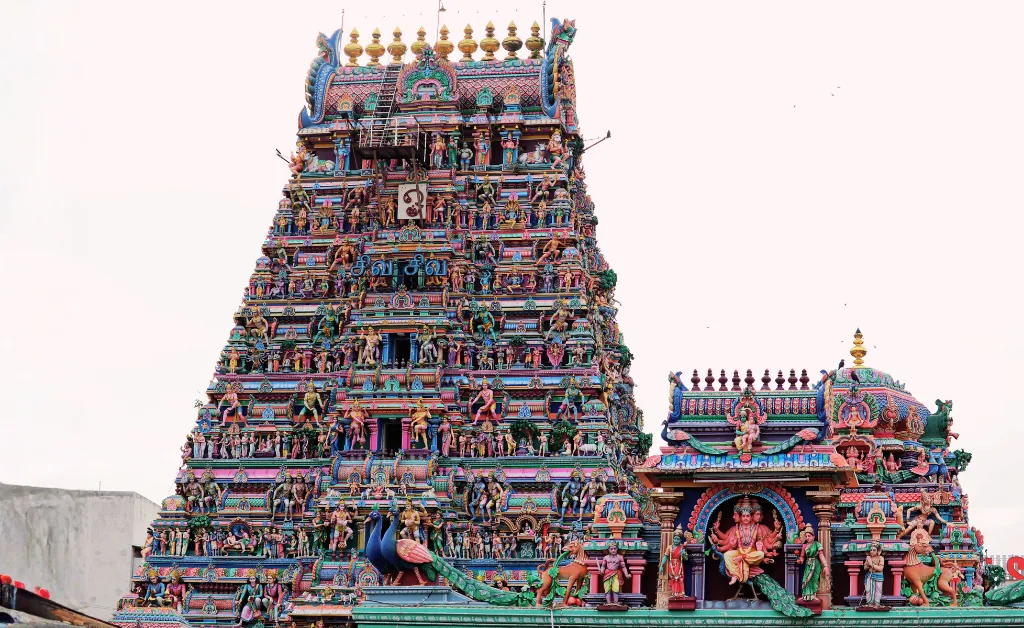
Kapaleeshwarar Temple, Mylapore
If you visit only one historical place in Chennai, make it this one.
Dedicated to Lord Shiva, Kapaleeswarar Temple is the architectural and spiritual heart of Mylapore — the oldest neighbourhood in the city. Its towering gopurams are covered in hundreds of painted sculptures depicting scenes from Tamil mythology, each one brighter than the last and repainted every 12 years in a tradition that hasn’t broken in centuries.
The original temple is believed to have stood here for over 1,300 years. The Portuguese destroyed it in the 16th century; it was rebuilt in its current form and has grown in scale and significance ever since. The tank beside the temple — Kapali Theertham — reflects the gopurams at dawn in a way that photographers and early-morning walkers quietly keep to themselves.
According to the itinerary plans team, come before 8 am. The lanes around the temple fill with flower sellers, kolam artists, and devotees buying jasmine by the metre. It’s one of the most sensory street experiences in the city.
- Address: 234, Ramakrishna Mutt Rd, Vinayaka Nagar Colony, Mylapore, Chennai, Tamil Nadu 600004, India
- Map: Kapaleeswarar Temple, Mylapore
- Timings: 6:00 AM – 12:30 PM | 4:00 PM – 8:00 PM
- Entry Fee: Free
- Contact: +914424641670
- Dress code: Shoulders and knees covered; men remove shirts before the inner sanctum
Arulmigu Sri Parthasarathyswamy Temple, Triplicane
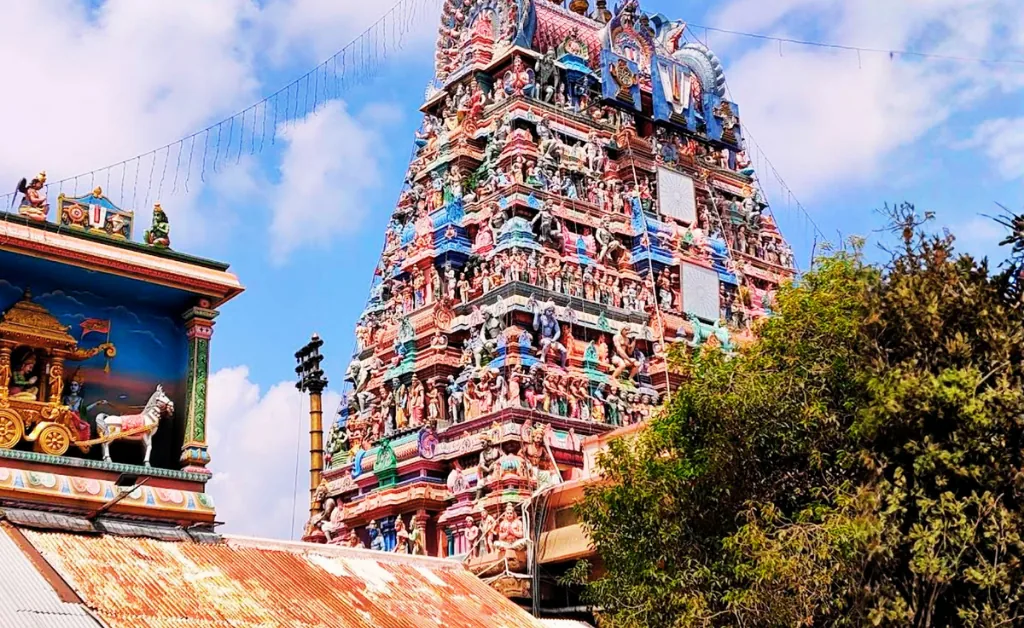
This is one of Chennai’s quietest historical treasures — and one of its oldest.
The Parthasarathy Temple dates to the 6th century, built during the Pallava period and later expanded under the Cholas and Vijayanagara kings. Dedicated to Lord Vishnu in his form as Parthasarathy (Krishna as Arjuna’s charioteer), the temple’s walls carry inscriptions from multiple dynasties — a layered historical record you can literally reach out and touch.
Unlike the more tourist-facing Kapaleeswarar, Parthasarathy draws primarily local devotees. That’s precisely what makes it worth visiting. The experience is unhurried, the architecture is magnificent, and the neighbourhood of Triplicane around it — one of the oldest in the city — rewards a slow walk.
- Address: Car St, Narayana Krishnaraja Puram, Triplicane, Chennai, Tamil Nadu 600005, India
- Map: Parthasarathyswamy Temple, Triplicane
- Timings: 76:00 AM – 12:00 PM | 4:00 PM – 9:00 PM
- Entry Fee: Free
- Parking: Free/paid, both available.
Marundeeswarar Temple, Thiruvanmiyur
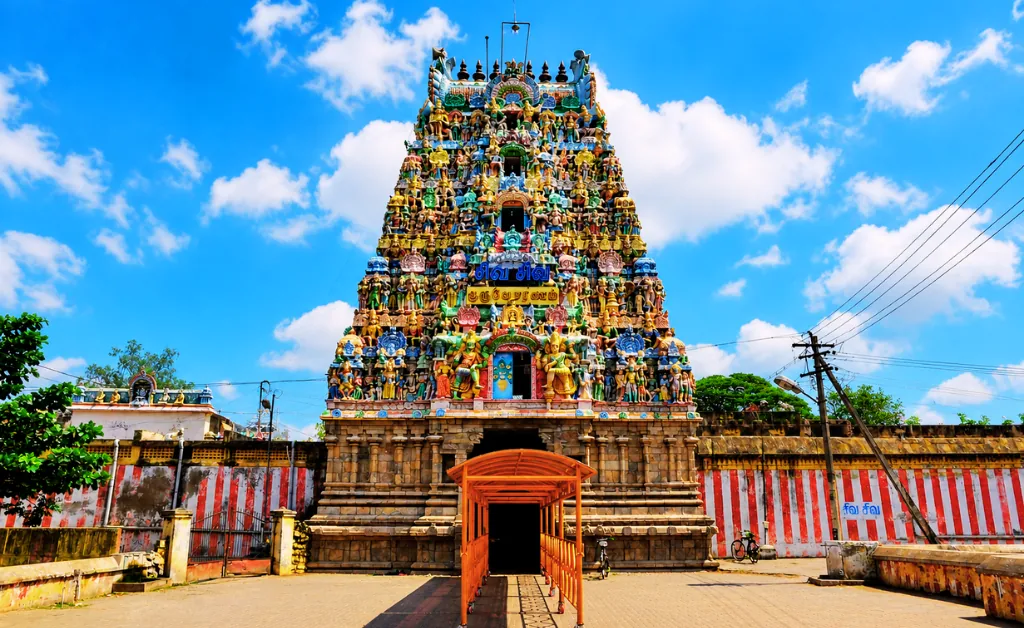
Less visited, more rewarding.
The Marundeeswarar Temple is dedicated to Shiva in his form as the God of Medicines, and has historically served as a pilgrimage site for those seeking healing. The Dravidian architecture is well-preserved, the gopuram is striking, and the crowd is almost entirely local — a genuine neighbourhood temple rather than a heritage attraction.
If you’ve spent a morning at Kapaleeswarar and want to see what Chennai’s temple culture looks like away from the tourist circuit, Thiruvanmiyur is 20 minutes south and worth the detour.
- Adres: 8, W Tank St, Ambedkar Nagar, Lalitha Nagar, Thiruvanmiyur, Chennai, Tamil Nadu 600041, India.
- Map: Marundeeswarar Temple, Thiruvanmiyur
- Timings: 5:30 AM – 12:00 PM | 4:00 PM – 9:00 PM
- Entry Fee: Free
- Contact: +914424410477

Colonial Landmarks — The British & Portuguese Footprint
The British arrived in 1639 and didn’t leave for over 300 years. The architecture they left behind — and the Portuguese structures that preceded them — form one of the most concentrated clusters of colonial heritage in South India.
Fort St. George
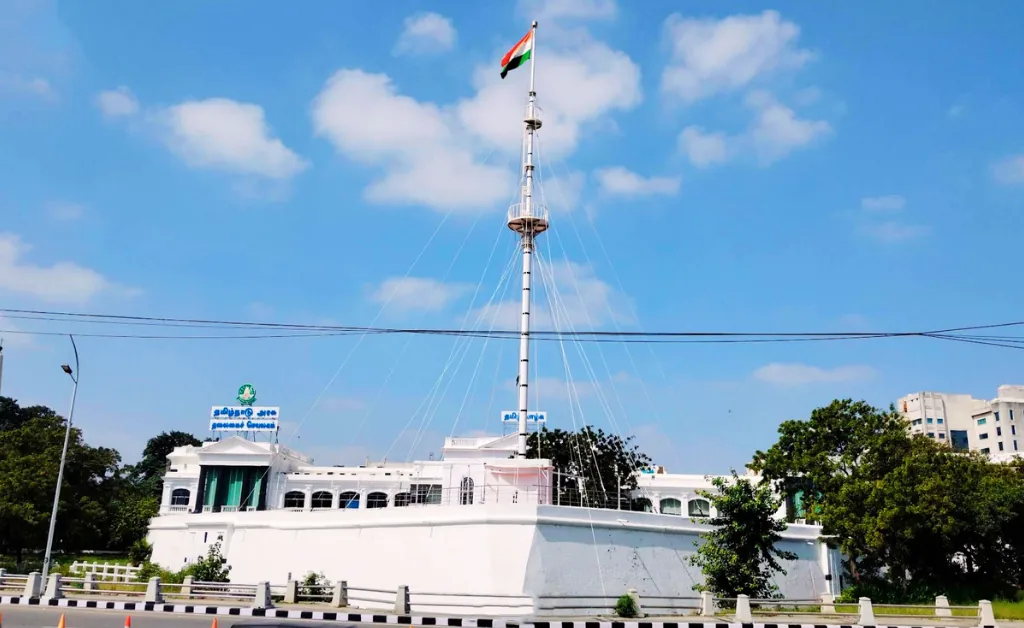
This is where Chennai began.
Fort St. George was built in 1644 by the British East India Company — the first English fortress constructed on Indian soil. It marked the start of British presence in the region, and everything that became Madras, and later Chennai, radiated outward from these walls.
Today the fort still functions as an active government complex, housing the Tamil Nadu Legislative Assembly and Secretariat. Within it, the Fort Museum holds colonial artefacts, uniforms, maps, and documents that trace the entire arc of British India from this single coastal outpost.
St. Mary’s Church inside the fort is the oldest surviving British church in India, consecrated in 1680. The register of marriages inside includes names that shaped the subcontinent — Robert Clive was married here.
The museum is modest in size but genuinely rich in content. Give it 90 minutes and leave with a far clearer understanding of how this city came to exist.
- Location: Fort St. George, Chennai
- Timings: 9:00 AM – 5:00 PM | Closed Fridays
- Entry Fee: ₹15 (Indians) / ₹200 (foreigners)
Santhome Cathedral Basilica
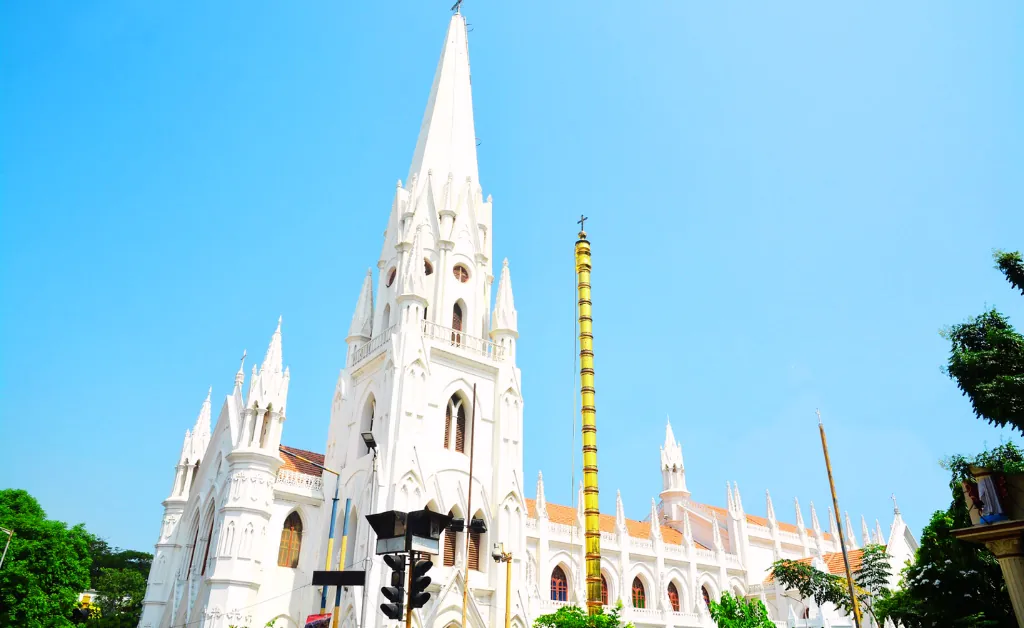
Few buildings in India carry the historical weight of Santhome.
The cathedral was built in 1896 in Gothic style by the Portuguese, over a site they believed to be the burial place of St. Thomas the Apostle — one of the twelve disciples of Jesus, believed to have brought Christianity to India in AD 52 and martyred in Chennai in AD 72.
Santhome is one of only three churches in the world built over the tomb of an apostle of Jesus. That places it alongside St. Peter’s Basilica in Rome and Santiago de Compostela in Spain. For a building on a Chennai beachfront street, that context is extraordinary.
The museum inside preserves paintings depicting the apostle’s life, the lance believed to have killed him, an episcopal chair, and what is claimed to be his fingerprint preserved on stone. Whether or not you approach it with faith, the history is undeniable.
The building’s white Gothic facade against the blue sky on the coast makes it one of the most photographed historical sites in the city.
- Address: 38, Santhome High Rd, Santhome, Mylapore, Chennai, Tamil Nadu 600004, India.
- Map: Santhome Cathedral Basilica
- Timings: 5:00 AM – 8:00 PM daily
- Entry Fee: Free | Museum: small suggested donation
Madras High Court
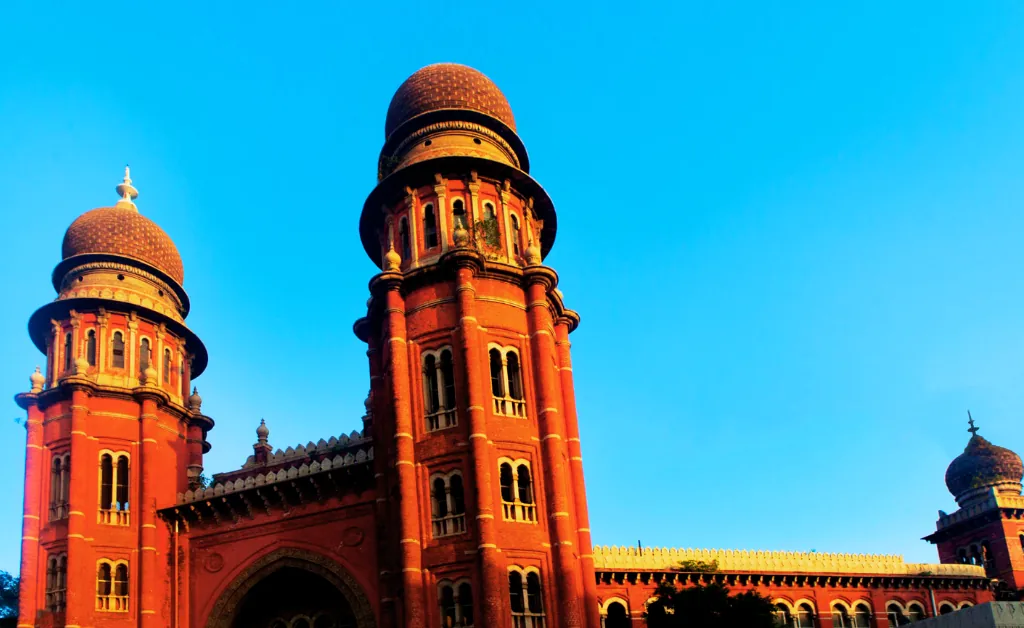
You don’t need to go inside to feel the scale of this building.
Constructed in 1892, Madras High Court is one of the largest court complexes in the world and a masterpiece of Indo-Saracenic architecture — a style that blends Mughal arches, Gothic columns, Dravidian towers, and British civic design into something that shouldn’t work but absolutely does.
The exterior alone, stretching along the waterfront near Fort St. George, stops most people on the pavement. The red sandstone facade, the lighthouse integrated into the building’s structure, and the sheer acreage of the complex make it unlike any other court building in India.
Interior visits require prior arrangement, but a slow walk along the outside is a legitimate heritage experience in itself.
- Location: Madras High Court
- Timings: Exterior accessible anytime
- Entry Fee: Free (exterior)
Connemara Public Library
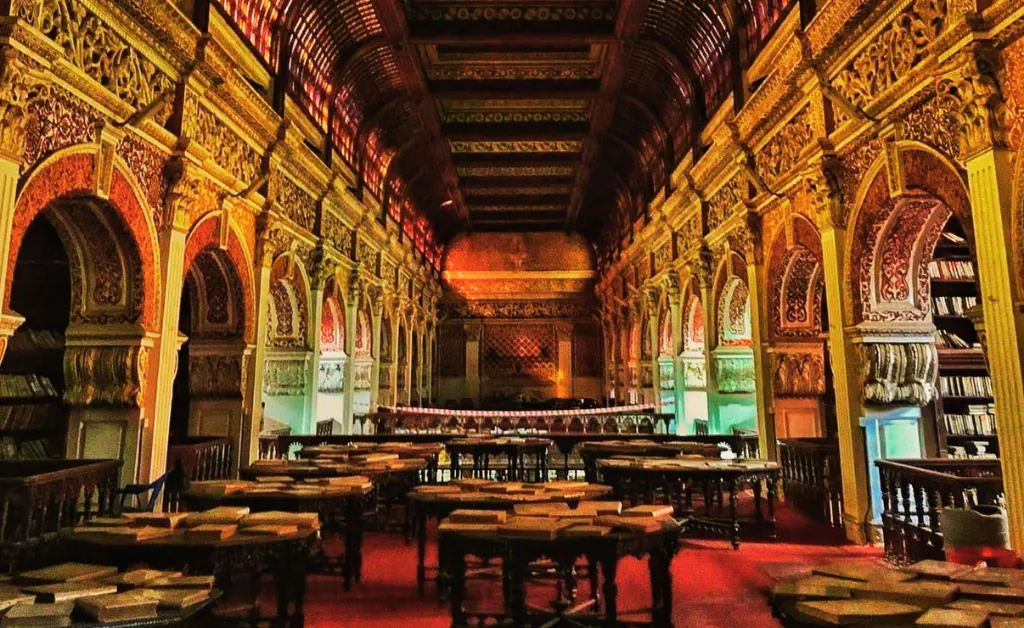
One of India’s most beautiful libraries — and one of its most important.
Built in 1890 and named after Lord Connemara, a former British Governor of Madras, the Connemara Public Library is one of four National Depository Libraries in India — meaning it receives a legal copy of every book, newspaper, and journal published in the country. Its collection exceeds 600,000 items, including a Bible printed in 1608 and a set of rare palm-leaf manuscripts.
The architecture is Indo-Saracenic, ornate, and well-maintained. The reading rooms are cool, quiet, and used daily by students and researchers. A Braille section and an IAS study centre sit alongside colonial-era map collections.
For visitors with any interest in archives, design, or colonial history, this is one of Chennai’s most underrated heritage destinations. Arrive on a weekday morning and you’ll find scholars, students, and the occasional curious traveller sharing the same high-ceilinged reading room.
- Address: 37C4+5PC, Pantheon Rd, Chennai, Tamil Nadu 600008, India.
- Map: Connemara Public Library, Egmore
- Timings: 8:00 AM – 8:00 PM | Closed national holidays
- Entry Fee: Free
- Contact: +914428193751
Museums — Where the History Is Curated
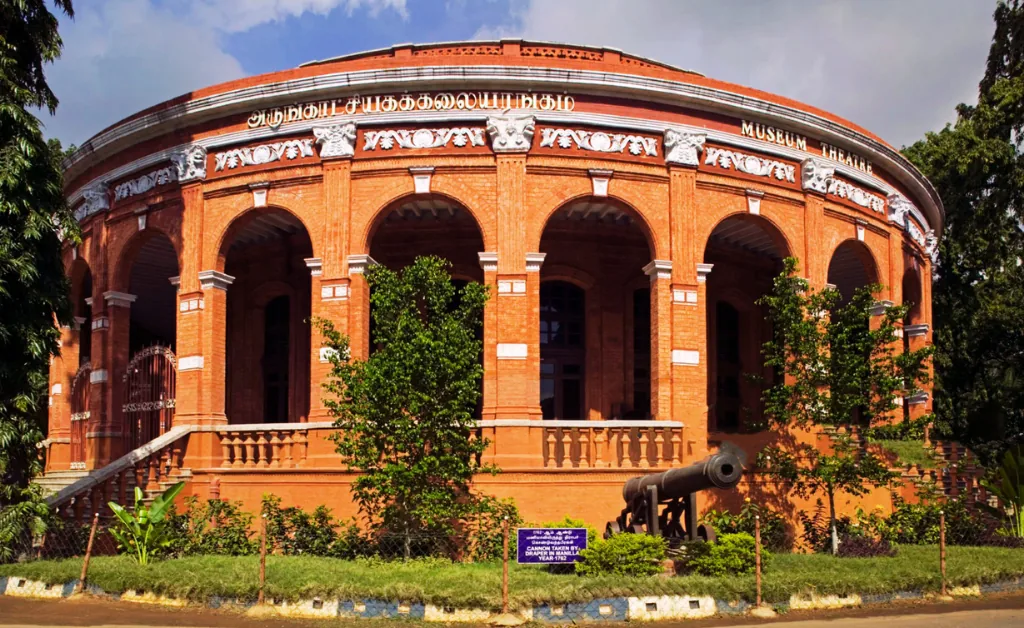
Government Museum, Egmore
India’s second-oldest museum — and arguably its most under-visited major collection.
Established in 1851, the Government Museum campus in Egmore spans 16.25 acres across six buildings: the Main Building, National Art Gallery, Bronze Gallery, Children’s Museum, Contemporary Art Gallery, and Front Building. You could spend a full day here and still not exhaust it.
The Bronze Gallery is the reason serious visitors come. It holds one of the finest collections of Chola bronze sculptures in the world — pieces dating to the 9th and 10th centuries that represent the peak of South Indian metalwork. The Nataraja (dancing Shiva) bronzes here are museum-quality in the truest sense.
The National Art Gallery building itself, built in 1906 in Mughal-Gothic style, is worth photographing before you even walk in.
- Location: Government Museum, Egmore
- Timings: 9:30 AM – 5:00 PM | Closed Fridays
- Entry Fee: ₹15 (Indians) / ₹250 (foreigners) | Camera: ₹200
Vivekananda House (Ice House), Marina Beach
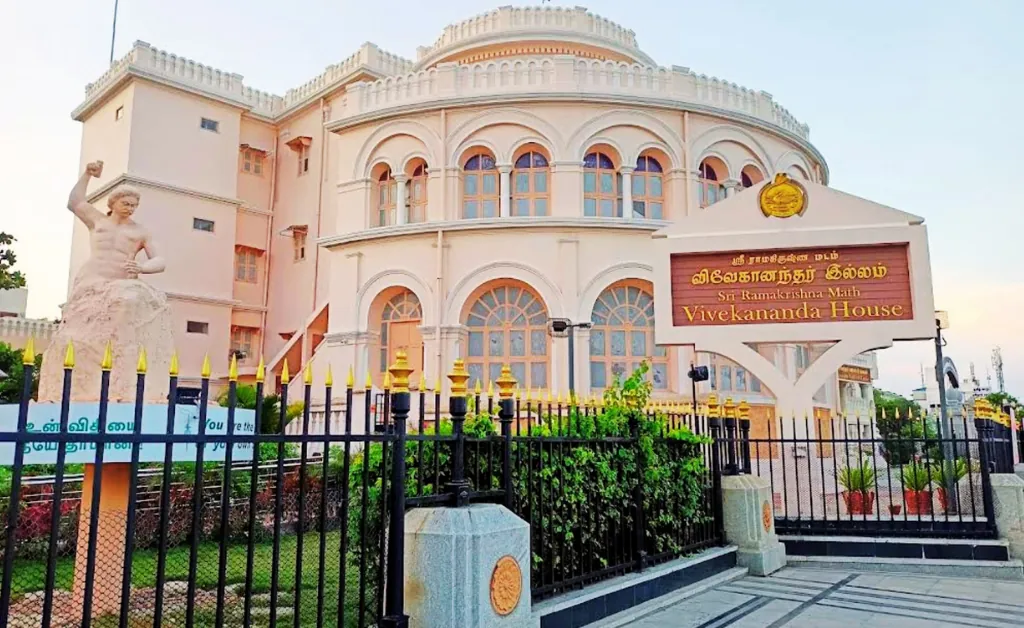
The building has one of the more unlikely histories in Chennai.
Originally built in the 19th century to store ice imported from the United States — before refrigeration existed — the Ice House later became a residence. Swami Vivekananda stayed here in 1897 on his return from the West after delivering his famous address at the 1893 Parliament of Religions in Chicago.
The semicircular pink building now functions as a museum dedicated to Vivekananda’s life and philosophy, with exhibitions, a meditation room, and a 3D film recreating his Chicago speech. The room where he lived is preserved.
It sits right on Marina Beach Road, making it easy to pair with a morning beach walk — and it’s one of the few heritage experiences in Chennai that’s completely free.
- Address: VIVEKANANDA HOUSE, Kamaraj Salai, Marina Beach Road, Triplicane, Chennai, Tamil Nadu 600005, India.
- Map: Vivekananda House, Marina Beach
- Timings: 10:00 AM – 12:45 PM | 3:00 PM – 7:00 PM | Closed Mondays
- Contact: +914428446188
- Entry Fee: Free
Post-Independence Monuments — Tamil Identity in Stone
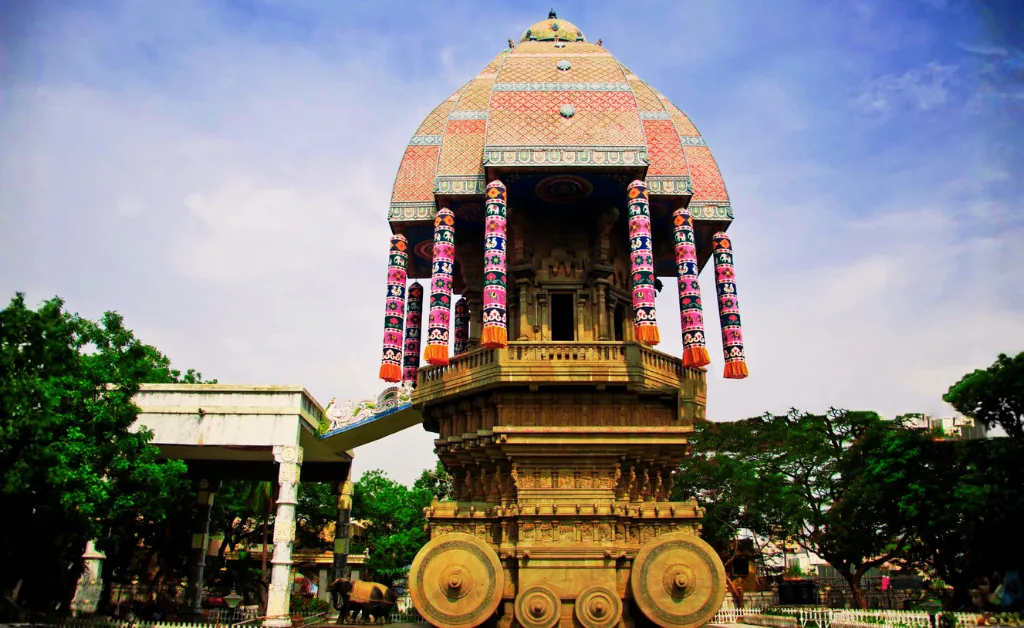
Valluvar Kottam, Nungambakkam
Built in 1976 to honour Thiruvalluvar — the Tamil poet-philosopher whose 2,000-year-old work Thirukkural remains one of the most quoted texts in Tamil culture — Valluvar Kottam is designed to resemble a temple chariot at a scale that stops traffic.
The structure stands 35 metres tall. All 1,330 couplets of the Thirukkural are engraved across the complex. An air-conditioned auditorium inside regularly hosts cultural exhibitions and performances.
Visit at dawn or dusk. The stone catches the light at those hours in a way that makes the scale hit differently.
- Location: Valluvar Kottam, Nungambakkam
- Timings: 8:00 AM – 8:00 PM
- Entry Fee: ₹5
Marina Beach Memorial Promenade
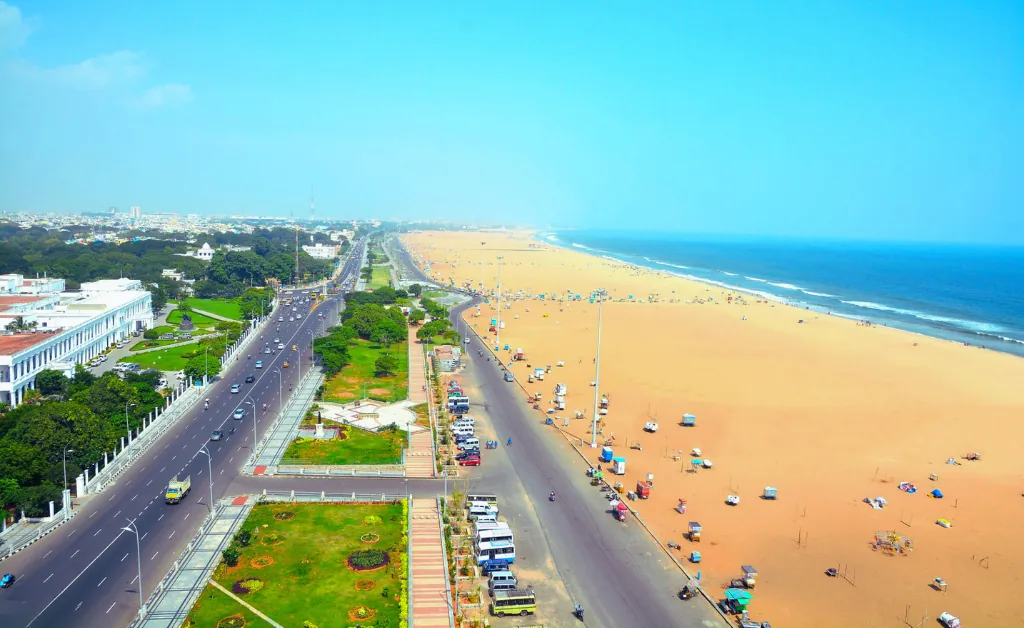
Most visitors think of Marina as a beach. It’s also an open-air museum of Tamil political history.
The 13-kilometre promenade is lined with statues of Tamil Nadu’s most significant post-independence figures — Anna (C. N. Annadurai), MGR (M. G. Ramachandran), Jayalalithaa, Kamaraj, and others — each with memorial grounds that draw devoted visitors daily.
Walking the length of the promenade from the lighthouse south toward Santhome is one of the best free heritage walks in India. Pair it with a sunrise start, a stop at Vivekananda House, and a filter coffee at one of the beachside stalls.
For a fuller picture of what the coast has to offer beyond the memorials, our guide to Chennai’s beaches covers every significant stretch along the waterfront.
- Location: Marina Beach, Chennai
- Timings: Open 24 hours | Best: 5:30–8:30 AM
- Entry Fee: Free
Day Trip Worth Adding: Mahabalipuram (60km from Chennai)
No guide to Chennai’s historical places is complete without mentioning what’s 60 kilometres south.
Mahabalipuram — officially Mamallapuram — was the port city of the Pallava dynasty in the 7th and 8th centuries. The rock-cut temples, bas-relief carvings, and the Shore Temple on the Bay of Bengal represent one of the earliest experiments in Dravidian stone architecture, and the entire site is a UNESCO World Heritage Site.
The Shore Temple at sunrise, before tour buses arrive, is one of the genuinely memorable experiences in Tamil Nadu. Arjuna’s Penance — a 27-metre bas-relief carved into a single rock face — is the largest outdoor rock relief in the world.
Drive down the East Coast Road (ECR) — the road itself is a reason to make the trip.
- Address: Beach Rd, Mahabalipuram, Tamil Nadu 603104, India.
- Location: Mahabalipuram Shore Temple
- Timings: 6:00 AM – 6:00 PM
- Entry Fee: ₹40 (Indians) / ₹600 (foreigners)
- Distance from Chennai: 60km via ECR — approximately 90 minutes
 |
India Travel Guide This guide explains India’s regions, best times to visit, essential entry steps, and transportation options. |
Practical Tips for Visiting Historical Chennai
Best time to visit November to February offers the most comfortable sightseeing conditions. If you’re deciding when to plan your trip around heritage visits, our guide on the best time to visit Chennai breaks it down by season, budget, and travel style.
Plan by neighbourhood, not by category Group your visits geographically to avoid backtracking:
- Day 1 morning: Mylapore (Kapaleeswarar, walk the lanes, filter coffee)
- Day 1 afternoon: Marina corridor (Vivekananda House, memorial walk, Santhome at sunset)
- Day 2 morning: Fort St. George + Madras High Court (both near each other on the waterfront)
- Day 2 afternoon: Egmore (Government Museum, Connemara Library)
- Day 3: Mahabalipuram day trip
Dress code for temples All temples require covered shoulders and knees. Men must remove shirts before entering the inner sanctum of most Tamil temples. Scarves or lightweight cotton wraps are easy to carry.
Photography rules
- Fort Museum: restricted — check at entrance
- Kapaleeswarar inner sanctum: not permitted
- Government Museum: ₹200 camera fee applies
- All exterior and promenade sites: freely permitted
Evenings are underrated Several of Chennai’s colonial buildings are beautifully lit after dark — Fort St. George, Madras High Court, and Santhome Cathedral especially. If you’re wondering what to do with evenings in the city, our guide to things to do in Chennai at night includes heritage-lit walks alongside the city’s after-dark food and cultural scene.
Some useful articles about India you may read
- Best Time to Visit India
- Visa Requirements for India
- Top Tourist Attractions to Visit During Your Trip to India
- Explore India Travel Guide for International Visitors 2026
FAQs — Historical Places in Chennai
Q: What is the oldest historical place in Chennai?
A: The Parthasarathy Temple in Triplicane, dating to the 6th century Pallava period, is among the oldest surviving historical sites in Chennai. Kapaleeswarar Temple in Mylapore is also believed to have origins from the same era, though the current structure was rebuilt in the 16th century.
Q: Is Fort St. George open to the public?
A: Yes. The Fort Museum and St. Mary’s Church are open to visitors daily except Fridays, from 9am to 5pm. Entry is ₹15 for Indian nationals and ₹200 for foreign visitors. The Tamil Nadu Legislative Assembly within the fort complex is not publicly accessible.
Q: How many days do I need to cover Chennai’s historical places?
A: Two full days covers the main sites within the city. Add a third day for the Mahabalipuram day trip, which is a UNESCO World Heritage Site 60km south along the East Coast Road. Most individual sites require 1–2 hours each.
Q: Are the historical places in Chennai free to visit?
A: Most temples and churches are free. The Government Museum charges ₹15 for Indians, Fort St. George charges ₹15, and Valluvar Kottam charges ₹5. Mahabalipuram is ₹40 for Indians. Connemara Library and Vivekananda House are free.
Q: What is the best area in Chennai for heritage walks?
A: Mylapore is the most rewarding neighbourhood for a heritage walk — ancient temple, colonial-era streets, traditional flower markets, and some of the city’s best South Indian restaurants within a compact area. George Town near the fort is the second best, particularly for colonial-era architecture.
Q: Can I visit historical sites in Chennai during summer?
A: Yes, but plan outdoor visits for early morning (before 10am) and late afternoon (after 5pm). Museums, the Connemara Library, and Fort St. George are air-conditioned and perfectly manageable in summer heat. April and May offer the shortest queues and lowest accommodation prices.
Conclusion
Chennai’s history doesn’t ask you to admire it from a distance. It pulls you into a 7th-century temple at dawn, seats you in a 130-year-old reading room, and walks you past a Gothic cathedral that holds the tomb of an apostle.
The historical places in Chennai span a range that few cities anywhere in the world can match — from Pallava rock carvings to British colonial architecture to Tamil cultural monuments, often within a few kilometres of each other.
Start with Mylapore. Stay through the evening. Come back for Mahabalipuram.
The city rewards everyone who slows down enough to actually look at what’s still standing.